|
Maps :: Kingsport
Maps :: Kingsport
Click To Enlarge
Lochaber Treaty Line
And Donelson’s Survey
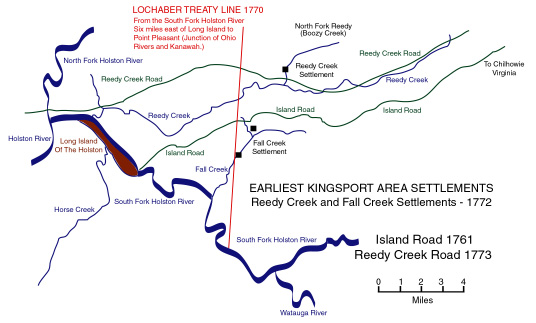
The Lochaber Treaty line began not in the vicinity of the Long Island of the Holston but at the intersection of
the Hard Labour line with the Virginia-North Carolina boundary, the 36º 30' parallel, and ran along that parallel
to the point six miles east of the Long Island in the South Fork of the Holston, and from there northward to the
mouth of Kanawah (Ramsey’s Great Kenhawa). In 1771, when the line was being surveyed by Col. Donelson and some
Cherokee chiefs, including Little Carpenter, it was discovered that some settlers had located between the 36º 30'
and the south fork of the Holston (presumably the sapling Grove [Bristol] and the Keywood settlements). Little
carpenter said he “pitied them“ and therefore consented to having the boundary run from the intersection
of the 36º 30' parallel with the river along the course of the river to the point six miles east of the Long Island.
Thus the “North of the Holston” settlers were recognized as being outside Indian country; and since the
Lochaber line was also considered to be North Carolina-Virginia boundary, those settlers, although within the present
Tennessee, were governed by the colony, and later the state of Virginia until 1779. Also, the Indians agreed,
in exchange for the promise of 500 English pounds worth of goods, which seems never to have been paid, to have
the Lochaber line run not from the vicinity of the Long Island directly to the mouth of the Kanawha, but instead
to the headwaters of the Kentucky River (called by Donelson the Louisa), along that river to the Ohio, and up the
Ohio, to the mouth of the Kanawha. Donelson’s map of that line was recently discovered in the British Public Record,
and a tracing from it accompanies Louis de Vorsey, Jr., “The Virginia-Cherokee Boundary of 1771,” in E.T.H.S.
Publications, No. 33 (1961), 17-31, and is also printed in his Indian Boundary, 80. There is in this work, however,
an unfortunate error in his modern representation, p. 70 of the Lochaber line. It should run, as indicated above,
from near the Long Island (Kingsport) northward to the mouth of the Kanawha, instead of farther east as show on the
map, but given correctly in the text, p. 77.
_____
Source : Annotations Relating Ramsey’s Annals of Tennessee to Present Day Knowledge. By
Stanley J. Folmsbee. pp. 754, 755. From : Annals of Tennessee. J. G. M. Ramsey, M.D., 1853. Reprint 1967 by
the East Tennessee Historical Society,
Knoxville, TN.
http://www.tngenweb.org/cessions/colonial2.html
Evading the 1763 Proclamation
The Greenbrier and Loyal Companies
[The Virginia legislature appointed as their representatives for treaty matters, Col.
Andrew Lewis, head of the Greenbrier Company, and Dr. Thomas Walker, head of the
Loyal Company.]
“ . . . After the Treaty of Fort Stanwix in 1768, which established the boundary lines to the north of Virginia,
Lord Shelburne in London
was anxious to settle the entire western frontier in order to avoid Indian wars. He ordered John Stuart, superintendent of
Indian affairs for the southern department, to fix the frontier to the south. Lewis and Walker, the Virginia commissioners,
wanted to move the boundary as
far west as possible in order to make legitimate the claims of the Greenbrier and Loyal companies. John Stuart,
however, agreed with the Cherokee chiefs that the line of the boundary should run to the mouth of the Great Kanawha
River in what is now West Virginia, rather than farther west to the Ohio River alongside what we now call Kentucky.
The Virginia commissioners worked through their political friends and the House of Burgesses passed a request that
Stuart move the boundary to the Ohio River. The royal governor, however, had no choice but to back the superintendent
of Indian affairs and, with the reluctant signatures of Lewis and Walker appended, the Treaty of Lochaber, South Carolina,
in 1770, established the line at the Great Kanawha.
“Then an odd thing happened. By agreement with the Cherokee chiefs, for ‘a promise of £500 that
was never paid,’ the line was moved west to the Ohio River after
treaty signing. It was obvious that much rum flowed. John Stuart did not object since the change was made with
the consent of the Cherokees themselves. It is not
difficult to guess who offered the money to the Cherokee chiefs, for the line of the Loyal Company claim now
was extended even beyond the original grant.
“Dr. Walker, apparently in fear of reversal by the Privy Council, went to work immediately. By December 16, 1773, some
980 surveys were made, on which basis 201,554 acres of land, slightly more than one-quarter of the original grant, were
sold. Thomas Walker had succeeded, unlike the Ohio Company shareholders, in thwarting the declared policy of the British
Crown. This was due to his close contacts with the Virginia legislature, many of whose members had a personal interest in
his success. Indeed, the Virginia council was so subservient to Walker that when settlers established themselves on land
that the Loyal Company no longer owned, after the revocation of the patent in 1763, the sheriff was ordered to remove
the offenders unless they purchased their land from the company. In effect, settlers who by Virginia law had a
preemptive right to fifty acres, were forced to buy land they had already improved from a company whose charter had
lapsed. This would have been impossible, the evidence indicates, if it were not for the fact that Governor Dunmore
in Virginia and William Legge, Earl of Dartmouth in England (who had succeeded to the office of colonial secretary) both
were personally involved in the speculation.
“It almost goes without saying that Dr. Thomas
Walker in 1775 represented Albemarle County in the Virginia assembly as a member of the Revolutionary
Convention. Patriotism and land thirst were blood brothers in the Virginia planter aristocracy.”
From : Life, Liberty, and the Pursuit of Land : The Plunder of Early America
By : Daniel M. Friedenberg.
Prometheus Books, 1992; pp 115-116. ISBN: 0879757221
http://www.tngenweb.org/cessions/colonial2.html
The So Called Treaty of 1772
1772. “Early in this year the authorities of Virginia made a treaty with the Cherokees, by which a
boundary was fixed between them, to run from the White Top Mountain, in latitude thirty-six degrees thirty
minutes.”
_____
Source : Ramsey; Annals of Tennessee, p. 109.
Note : Charles C. Royce in his 5th Annual Report of the Bureau of Ethnology, p. 146, refers to this 1772
Treaty, however the only source that he cites is Ramsey, p. 109.
The Righting
There was no treaty between Virginia and the Cherokee Indians in 1772. Instead there were the Lochaber Treaty of
1770 and the Donelson survey of 1771.
_____
Source : Folmsbee; Annotations to ... Ramsey; Annals of Tennessee, p. 755.
http://www.tngenweb.org/cessions/colonial2.html
|
